2RHZE/4RH meaning: TB drugs, their side effects and why each is used
Dr Soala Reuben, Physician and pathology educator · 21 October 2026
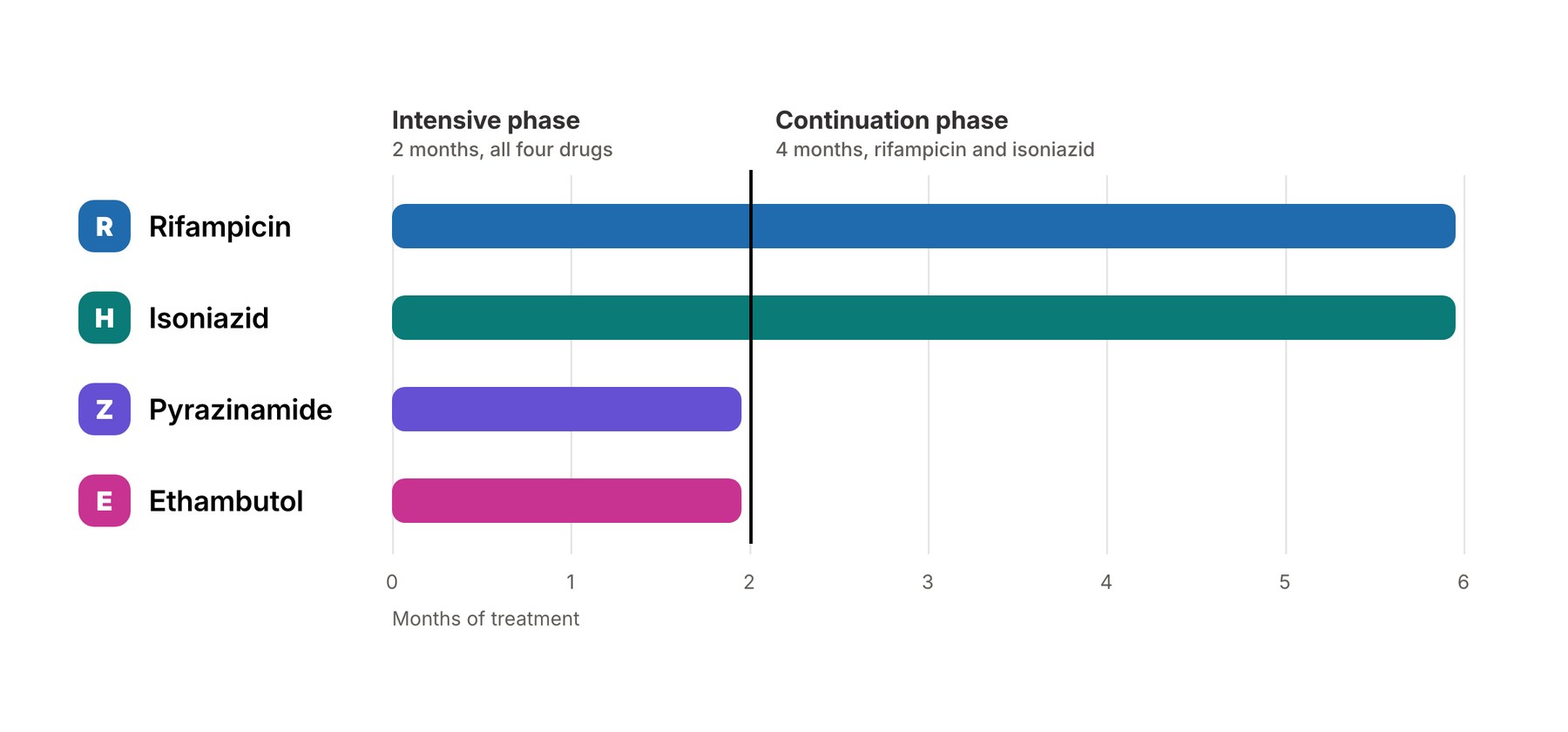
2RHZE/4RH is the standard treatment for drug-susceptible tuberculosis in Nigeria: rifampicin (R), isoniazid (H), pyrazinamide (Z) and ethambutol (E) for two months, then rifampicin and isoniazid for four months. That's six months in all.
What does 2RHZE/4RH mean?
The number is the months and the letters are the drugs. The first part, 2RHZE, is the intensive phase: all four drugs for two months. The second part, 4RH, is the continuation phase: rifampicin and isoniazid for four more months. Nigeria's guidelines write it 2(RHZE)/4(RH). American textbooks use the mnemonic RIPE for the same four drugs.
| Drug | Letter | Phase | Why it's there |
|---|---|---|---|
| Rifampicin | R | Both | One of the two main drugs; kills organisms inside and outside cells |
| Isoniazid | H | Both | One of the two main drugs; acts on rapidly growing bacilli |
| Pyrazinamide | Z | Intensive only | Reaches bacilli in acidic lesions and inside macrophages |
| Ethambutol | E | Intensive only | Covers the start of treatment until susceptibility is known |
Why are four TB drugs given together?
Because of resistance. Any large population of M. tuberculosis already holds a few organisms that are naturally resistant to any one drug. Treat with one drug and those organisms take over. That's what happened when streptomycin was given alone. With several drugs, an organism resistant to one is killed by the others. For the same reason, rifampicin is never given alone for active tuberculosis.
Why are pyrazinamide and ethambutol stopped after two months?
Pyrazinamide does most of its good early in treatment, and longer use adds to its liver toxicity. Ethambutol is there until culture and susceptibility results are known, and may be stopped once the organism is known to be sensitive to the other three.
How long is TB treatment?
Six months for drug-susceptible tuberculosis. Patients feel better within weeks, but the organism grows slowly, dividing only every 18 to 24 hours in the laboratory, and some bacilli persist long after. Stopping early lets them come back. The continuation phase is there to clear them and stop relapse.
How do the first-line TB drugs work?
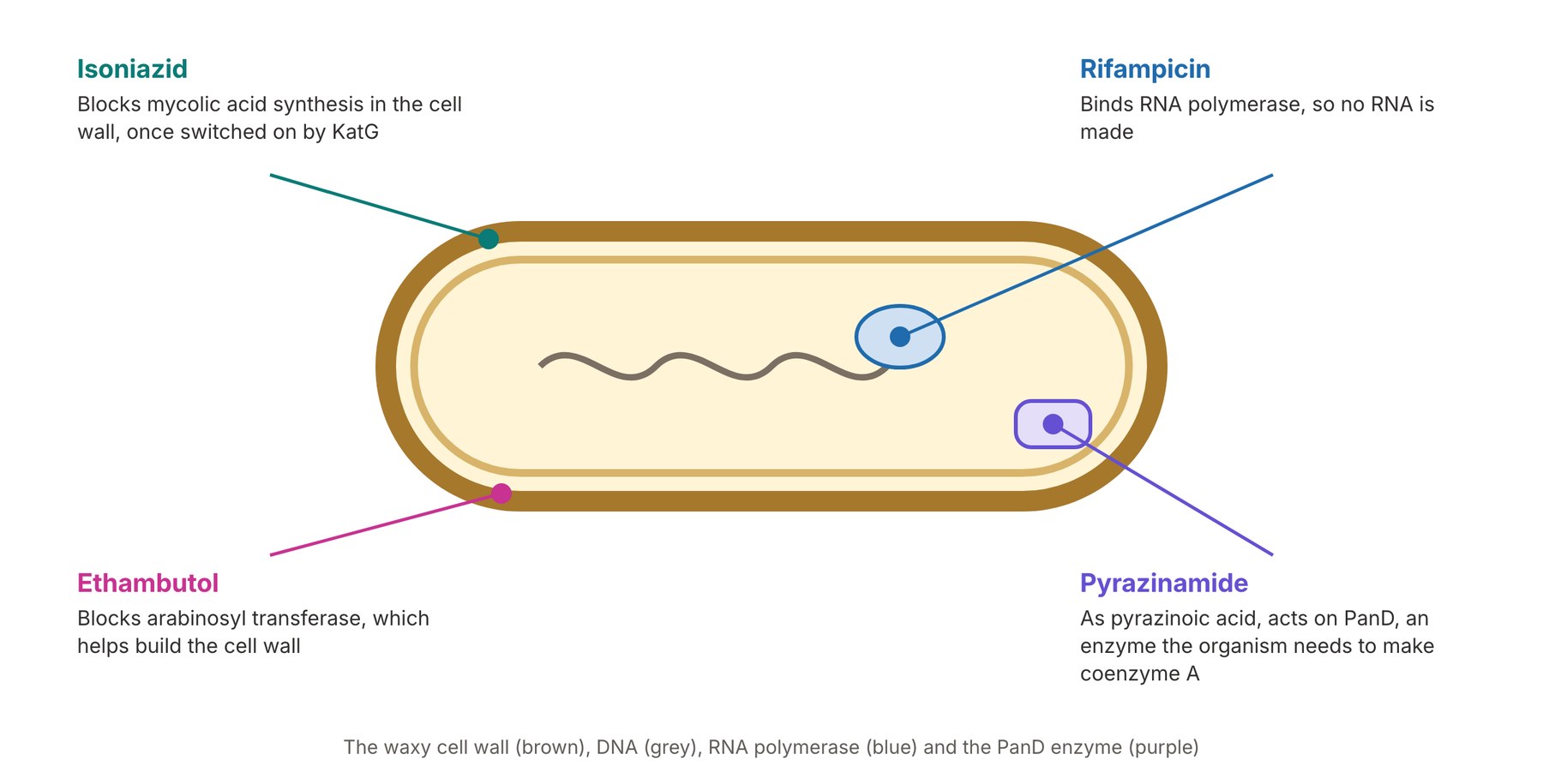
- Isoniazid: a prodrug switched on by a bacterial enzyme, KatG. Once active, it blocks the enzymes that build mycolic acid, so the organism can't make its cell wall.
- Rifampicin: binds the beta subunit of the bacterial RNA polymerase, so RNA can't be made. It kills organisms inside and outside cells.
- Pyrazinamide: a prodrug that bacterial pyrazinamidase converts to pyrazinoic acid. It works best in acidic lesions and inside macrophages.
- Ethambutol: blocks arabinosyl transferase, an enzyme that helps build the cell wall. It's bacteriostatic: it stops growth rather than killing.
What are the side effects of TB drugs?
| Finding | Drug | Why |
|---|---|---|
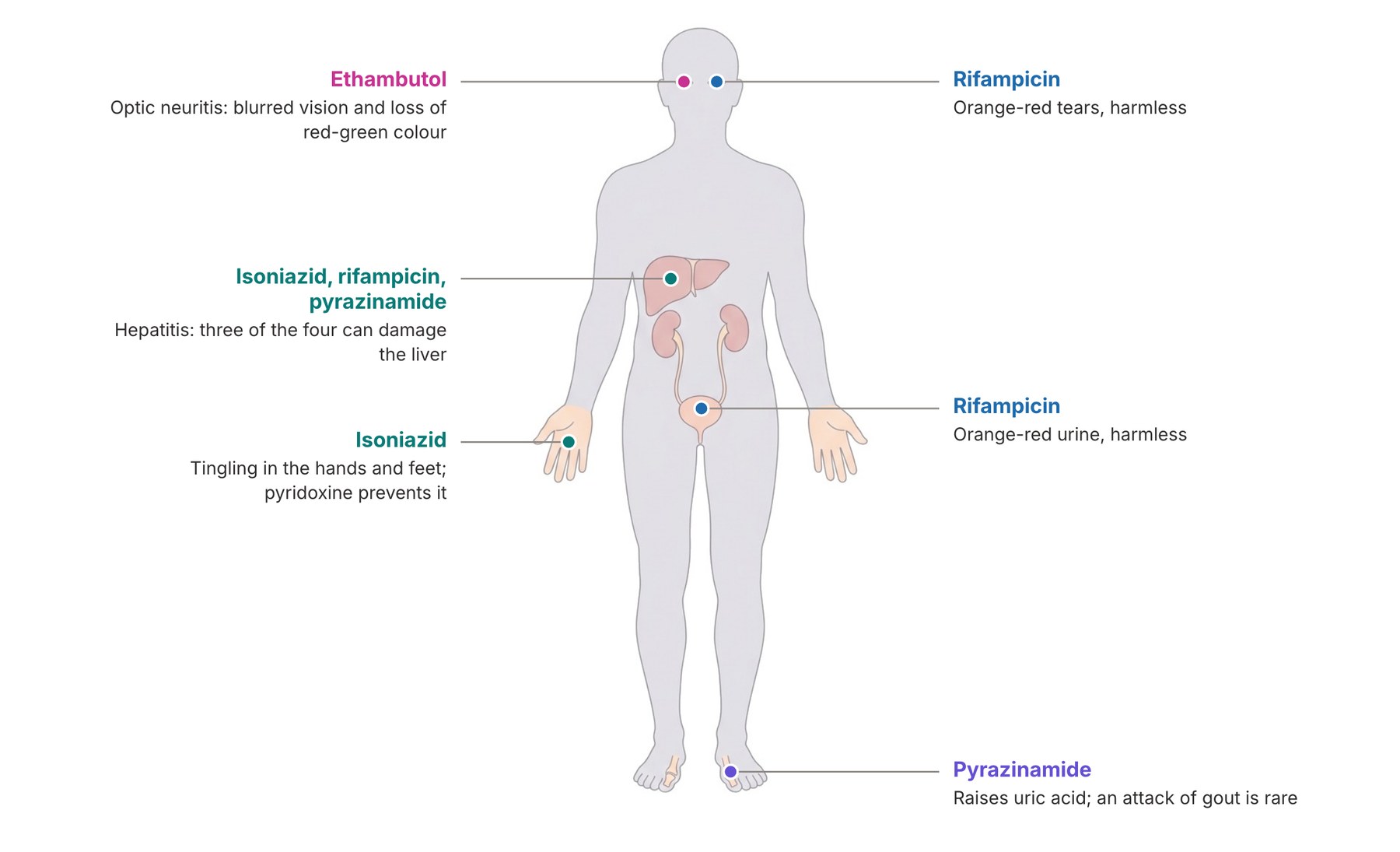
| Loss of red-green colour vision | Ethambutol | Optic neuritis; risk rises with higher doses and kidney impairment |
| Tingling in the hands and feet | Isoniazid | Relative pyridoxine deficiency; giving pyridoxine prevents it |
| Orange-red urine and tears | Rifampicin | Harmless, but it can permanently stain soft contact lenses |
| Raised uric acid | Pyrazinamide (and ethambutol) | Both reduce uric acid excretion; gout is rare |
| Jaundice | Isoniazid, rifampicin or pyrazinamide | All three can damage the liver, and all three start on the same day |
| Ring sideroblasts | Isoniazid | It antagonises pyridoxine, causing a sideroblastic anaemia |
Hepatitis is the most serious side effect of isoniazid, and it's commoner when rifampicin is given too.
Why is pyridoxine given with isoniazid?
To prevent peripheral neuropathy. Isoniazid causes a relative deficiency of pyridoxine (vitamin B6), felt as tingling in the hands and feet. Giving pyridoxine alongside it prevents this.
What drug interactions does rifampicin have?
Rifampicin speeds up the liver enzymes (cytochrome P450) that clear many other drugs, so their levels fall. This matters in HIV: protease inhibitors and several non-nucleoside reverse transcriptase inhibitors drop. Rifabutin is a much weaker inducer. Isoniazid works the other way for phenytoin and carbamazepine: it slows their breakdown, so their side effects grow stronger.
How long is treatment for TB meningitis?
The continuation phase runs for ten months instead of four: 2(RHZE)/10(RH), twelve months in all.
What is TB preventive therapy?
Treatment of latent infection in people at high risk of active disease, which Nigeria's guidelines call TB preventive treatment (TPT). Two regimens are used:
| Regimen | Drugs | How long |
|---|---|---|
| 6H | Isoniazid, daily | 6 months |
| 3HP | Isoniazid and rifapentine, weekly | 3 months |
It's for household contacts of a person with pulmonary tuberculosis, especially children under five, and people living with HIV. Active tuberculosis must be ruled out first. One or two drugs given for active disease would let the naturally resistant organisms take over.
Practise it
patandfam's tuberculosis module teaches the regimen alongside the morbid anatomy, microbiology, haematology and chemical pathology of the same disease, with timed questions, flashcards and a viva.
Sources
- NTBLCP, Federal Ministry of Health, Nigeria. National Tuberculosis, Leprosy and Buruli Ulcer Management Guideline, 7th edition
- Federal Ministry of Health, Nigeria. Nigeria Standard Treatment Guidelines 2022, Pulmonary tuberculosis
- Peloquin CA, Egelund EF. Antimycobacterial Drugs, chapter 32 of Lippincott Illustrated Reviews: Pharmacology
- Gopal P, Sarathy JP, Yee M, et al. Nature Communications 2020;11:1661. With Gopal P et al., ACS Infectious Diseases 2017;3:492-501. Pyrazinamide triggers degradation of its target aspartate decarboxylase
- National Tuberculosis, Leprosy and Buruli Ulcer Control Programme, Federal Ministry of Health, Nigeria, April 2023. Desk Guide for Prevention, Diagnosis and Treatment of Tuberculosis in Children and Adolescents in Nigeria, 4th edition
- World Health Organization, Geneva, 2020. WHO consolidated guidelines on tuberculosis, Module 1: prevention. Tuberculosis preventive treatment, 2020