How to study microbiology in medical school
Dr Soala Reuben, Physician and pathology educator · 21 October 2026
Learn every organism in the same six steps, put similar organisms side by side in tables, learn the stains and lab tests from pictures, and test yourself again and again over weeks. Then tie each organism to the disease it causes in pathology and the drugs that treat it in pharmacology.
Why is microbiology hard to study?
Microbiology can be hard because there are so many organisms, and each one comes with its own stain, spread, disease, test and drug. Read them one by one and they blur together. Give every organism the same shape in your notes, and you'll always know what you're looking for and what's missing.
What order should you learn each organism in?
Learn each organism in the same order every time:
- What it is: Gram stain, shape, and anything special about it.
- How it spreads.
- Virulence factors: what lets it cause disease.
- The disease it causes.
- How the lab diagnoses it: stains, culture and other tests.
- How it's treated, including drug resistance.
Tuberculosis in that order:
| Step | Mycobacterium tuberculosis |
|---|---|
| What it is | An obligate aerobe. Its cell wall is rich in mycolic acid, which makes it acid-fast. |
| How it spreads | In airborne droplet nuclei. The germs get into the air when someone with TB of the lungs or throat coughs, speaks or sings (CDC). |
| Disease | Tuberculosis |
| Lab diagnosis | Ziehl-Neelsen stain shows red rods on a blue background. It grows slowly: up to six weeks on solid culture. In Nigeria, GeneXpert MTB/RIF is the first test for presumptive TB. |
| Treatment | Four drugs, then two: 2(RHZE)/4(RH). GeneXpert also reports rifampicin resistance, and MDR TB is resistance to isoniazid and rifampicin. |
When a lecture skips a step, fill the gap from your textbook.
How do you remember so many organisms?
Compare organisms that look alike in one table, with the six steps as columns and the organisms as rows. Questions may ask how two similar organisms differ, and a table puts that difference in front of you. Fill in the table from memory first, then check it against your notes and correct it in a different colour.
Group organisms the way your course does: by Gram stain and shape for bacteria, or by type for viruses, fungi and parasites. Then build one table per group.
How do you learn the stains and lab tests?
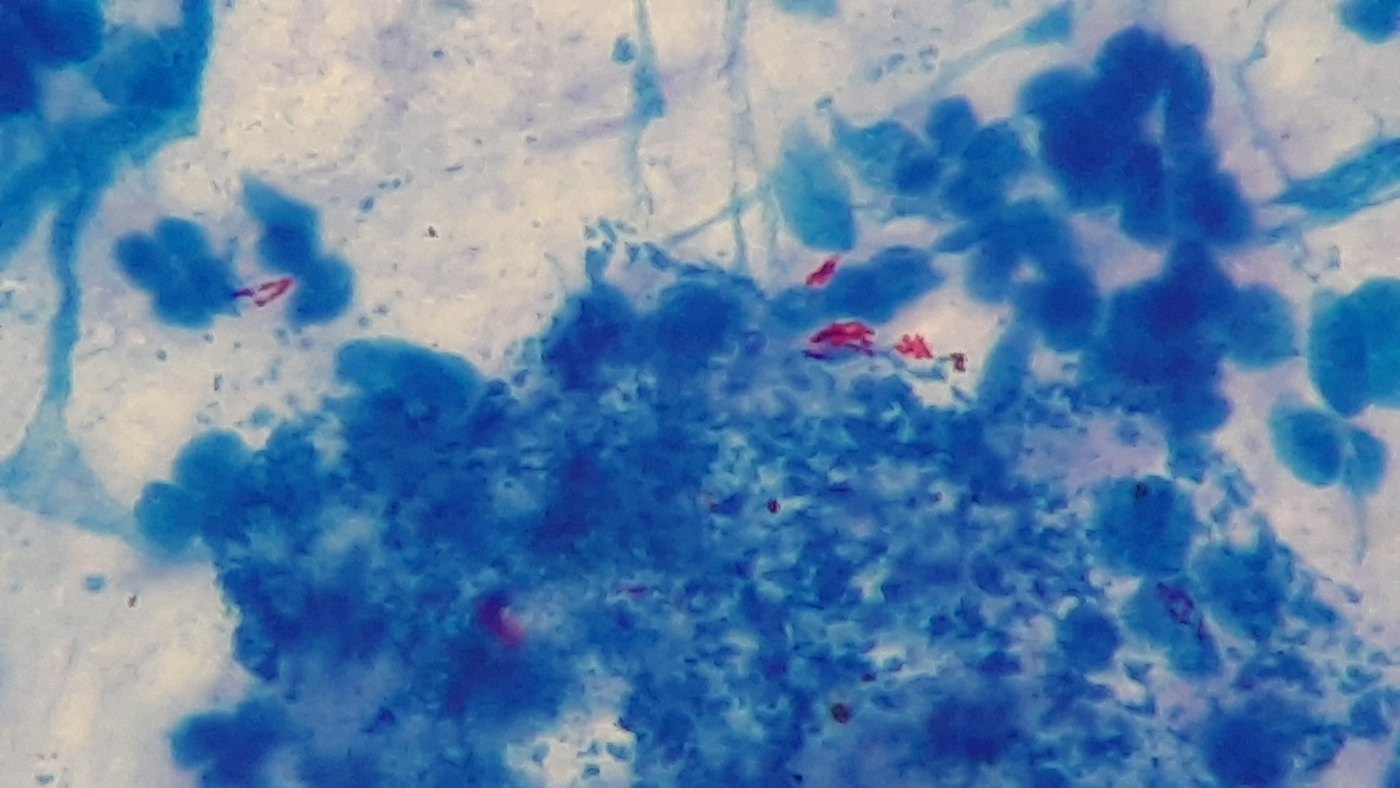

Learn each stain from a picture, and know what each step does. If you can explain why it stays red (its mycolic-acid-rich wall), you won't need to memorise the colours.
For each test, also learn what a negative result means: a negative smear doesn't rule out TB.
Should you start with a textbook or the lecture slides?
You can start with a short book for an overview, then use the slides. One student we interviewed reads a short microbiology book first to get the big picture, then skims the lecture slides, and keeps the book for its mnemonics.
How do you study microbiology for an exam?
Test yourself, and spread your study out over weeks instead of cramming. A large review of learning techniques rated practice testing and spreading practice over time as high utility, and rated rereading, highlighting and summarising as low utility (Dunlosky and colleagues, 2013). So close the book and recall before you reread.
Ways to test yourself:
- Blank tables: draw the six-step table for an organism and fill it from memory.
- Flashcards: one question per card, such as "What stain shows M. tuberculosis?" One student we interviewed makes flashcards with NotebookLM.
- Past questions: they show you how your school asks things.
- Explain it aloud: talk a friend through one organism, start to finish.
Come back to each topic a few days later, then a week or two after that. Each time, test first and reread only what you got wrong.
Where do you find microbiology and parasitology questions and answers?
Start with your own school's past questions, since they match your curriculum. Then turn each of the six steps into a question for every organism you study.
How do you study parasitology?
Study each parasite in the same fixed order, just as you do for bacteria and viruses:
- Life cycle: where it lives and the forms it passes through.
- Transmission: how it gets into people.
- Disease.
- Diagnosis: what the lab looks for, and in which sample.
- Treatment.
Draw each life cycle by hand from memory, then check it. Life cycles tie the other steps together: where the parasite sits in the body often tells you which sample the lab needs and how it spreads.
Can AI help you study microbiology?
AI can help you make questions and explain hard topics, but check what it tells you against your notes or textbook. One student we interviewed sends ChatGPT a photo of a slide they don't understand and asks it to explain.
How does microbiology link to pathology and pharmacology?
Each organism links to a disease you'll study in pathology and to drugs you'll study in pharmacology, so learn all three together. With TB:
- Microbiology: an acid-fast obligate aerobe that spreads in droplet nuclei.
- Lab: Ziehl-Neelsen stain, slow culture and GeneXpert MTB/RIF.
- Pharmacology: GeneXpert reports rifampicin resistance, and MDR TB is resistance to isoniazid and rifampicin.
Linking them also helps with long questions that start with a patient and move from the organism to the lab and then to the drugs.
Practise it
Try this method on one disease from start to finish in our tuberculosis module, which covers the organism, the pathology and the drugs together.
Sources
- Dunlosky J, Rawson KA, Marsh EJ, Nathan MJ, Willingham DT. Improving students' learning with effective learning techniques. Psychol Sci Public Interest 2013;14(1):4-58
- Centers for Disease Control and Prevention. How TB spreads / Causes of tuberculosis