How to study pharmacology in medical school
Dr Soala Reuben, Physician and pathology educator · 21 October 2026
Learn drugs by class: start with one prototype, and learn the same five things about every drug. Link each drug to the disease it treats, learn your own country's regimens, and test yourself over weeks instead of rereading your notes.
Why does pharmacology feel so hard?
Pharmacology can feel hard because it looks like a long list of names with no story. Of six Nigerian medical students we interviewed in October 2026, one said there weren't good videos or sources for pharmacology, so they asked an AI chatbot to teach a topic from the physiology up.
Give the list a structure, and each new drug becomes a small change to something you already know.

How do you study pharmacology by drug class?
Pick one prototype drug for each class and learn it well, then learn only what's different about the others. For beta blockers, learn propranolol in full. Then for each other beta blocker, ask how it differs: is it more selective for the heart, does it last longer, is it cleared by the kidney instead of the liver.
Drugs in one class mostly share a mechanism, so they share many of their uses and adverse effects.
What should you learn for each drug?
Learn the same five things for every drug, in the same order:
| What to learn | The question it answers |
|---|---|
| Mechanism | How does it work? |
| Uses | What do we give it for? |
| Key adverse effects | What harm can it do? |
| Important interactions | What happens with other drugs? |
| Contraindications | Who mustn't take it? |
Using the same order every time means you'll notice when you've skipped something.
Learn adverse effects from the mechanism
Where you can, work out the adverse effect from how the drug works instead of memorising it as a separate fact. If a drug blocks a receptor, think about what that receptor does elsewhere in the body. Not every adverse effect can be worked out like this, but many can.
Why should you link every drug to a disease?
Linking a drug to the disease it treats tells you why it works. Pathology explains what's gone wrong; the drug is aimed at that problem.
When you learn a disease, finish by asking which drug treats it and how. When you learn a drug, ask which disease it was made for. Each one helps you remember the other.
Should you learn your own country's regimens?
Yes, learn the regimens and notation your country's guidelines use, because that's what your exams and your future patients will follow. Foreign textbooks are useful for mechanisms, but they may write the same treatment a different way.
Nigeria's guidelines write the standard regimen as 2(RHZE)/4(RH). American texts teach the same four drugs with the mnemonic RIPE. If you've only seen RIPE, the Nigerian notation can look unfamiliar in an exam, even though you know the drugs.
A worked example: tuberculosis drugs
The regimen. Rifampicin (R), isoniazid (H), pyrazinamide (Z) and ethambutol (E) for two months, then rifampicin and isoniazid for four months. That's what 2(RHZE)/4(RH) means.
Why four drugs together. A large population of TB bacilli holds a few organisms that are resistant to any one drug. If you give one drug alone, those few survive and grow. Giving several drugs at once means an organism resistant to one is still killed by the others.
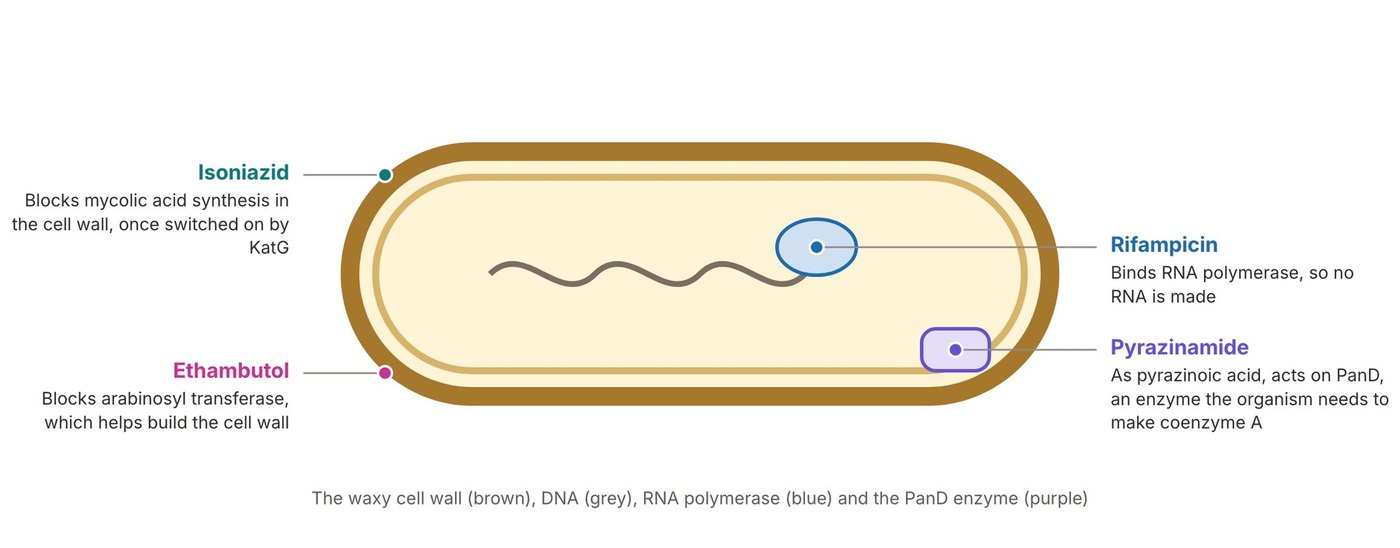
What to know about each drug:
| Drug | Adverse effects |
|---|---|
| Rifampicin | Turns urine and tears orange-red. Induces liver P450 enzymes, so many other drugs are cleared faster. Can damage the liver. |
| Isoniazid | Causes a relative pyridoxine deficiency, leading to peripheral neuropathy. Prevent it by giving pyridoxine. Can damage the liver. |
| Pyrazinamide | Can damage the liver. Raises uric acid, though an attack of gout is rare. |
| Ethambutol | Optic neuritis, with loss of red-green colour vision. |
Rifampicin's enzyme induction is the reason it has so many interactions, so that one fact covers a whole row of the table. And three of the four drugs can harm the liver, so learn them as a group.
For more on the notation and the two phases, read What 2RHZE/4RH means.
How do you study pharmacology effectively?
Test yourself, and space your study out over days and weeks. A large review of learning techniques by Dunlosky and colleagues rated practice testing and distributed practice (spreading study out over time) as high utility. It rated rereading, highlighting and summarising as low utility (Dunlosky et al., 2013).
To do that:
- Close the book and recall. Write the five headings for a drug and fill them in from memory. Then check.
- Come back later. Test yourself on a class a few days after you learnt it, then again a week or so later.
AI chatbots can help explain a mechanism. Check what they tell you against your textbook and your country's guidelines, and still test yourself afterwards.
What's the easiest way to remember drugs for exams?
Use cases that start from a patient, not from a drug name. Ask "which drug?" from a symptom. For example:
- A patient on TB treatment says red and green look the same to them. Name the drug likely to blame. Answer: ethambutol.
- Another has numbness and tingling in their feet. Name the drug and how it could've been prevented. Answer: isoniazid; giving pyridoxine.
Cases like these make you use the mechanism, the adverse effects and the disease link all at once.
Practise it
The tuberculosis module lets you try this method on TB: the pathology, the drugs and the Nigerian regimen, with questions to test yourself.
Sources
- Dunlosky J, Rawson KA, Marsh EJ, Nathan MJ, Willingham DT. Improving students' learning with effective learning techniques. Psychol Sci Public Interest 2013;14(1):4-58