Steeplechase exam in medicine: what it is and how to prepare
Dr Soala Reuben, Physician and pathology educator · 21 October 2026
A steeplechase is a timed practical exam. You move from station to station, and at each one you look at a specimen, slide, bone, image or instrument and answer a few questions before a bell tells you to move on. The number of stations, the time at each and the marking differ between schools and subjects.
What does steeplechase mean in medicine?
In medical school, a steeplechase is a practical exam where students rotate through a set of stations in a fixed order and on a fixed clock.
You'll also hear it called a "spot test", "spotters" or a "bell-ringer". Some schools run a more structured version and call it an OSPE (objective structured practical examination).
What is the steeplechase exam format?
The usual format:
| Feature | What usually happens |
|---|---|
| Stations | A row of tables, each with a specimen, slide, bone, image or instrument |
| Questions | One or more short questions per station |
| Timing | A fixed time per station, signalled by a bell |
| Movement | Everyone moves to the next station at the same time, in one direction |
| Going back | Usually not allowed |
| Answers | Written on an answer sheet, often short answers or single best answer |
At Cambridge, one first-year anatomy steeplechase had 30 stations, three minutes each, with single-best-answer questions.
Some schools give less than a minute per station, some ask you to write short descriptions, and some mix in viva questions. Check your own school's past steeplechases and ask your seniors how many stations there are, how long you get, and how it's marked.
Is there a steeplechase in anatomy?
Yes, and anatomy is where many students meet the steeplechase first. You may be asked to name a tagged structure on a bone, prosection or radiograph, then answer a follow-up about its nerve supply, blood supply, function or clinical relevance.
The steeplechase can carry real weight in your overall result. In one Lagos State University class, steeplechase scores closely tracked overall anatomy results.
What does a pathology steeplechase look like?
In pathology, the stations are usually pots (gross specimens in jars) and slides under a microscope or shown as photographs. At each station you're expected to do three things: describe what you see, identify the disease, and explain something about it, such as the cause, the next test or a complication.
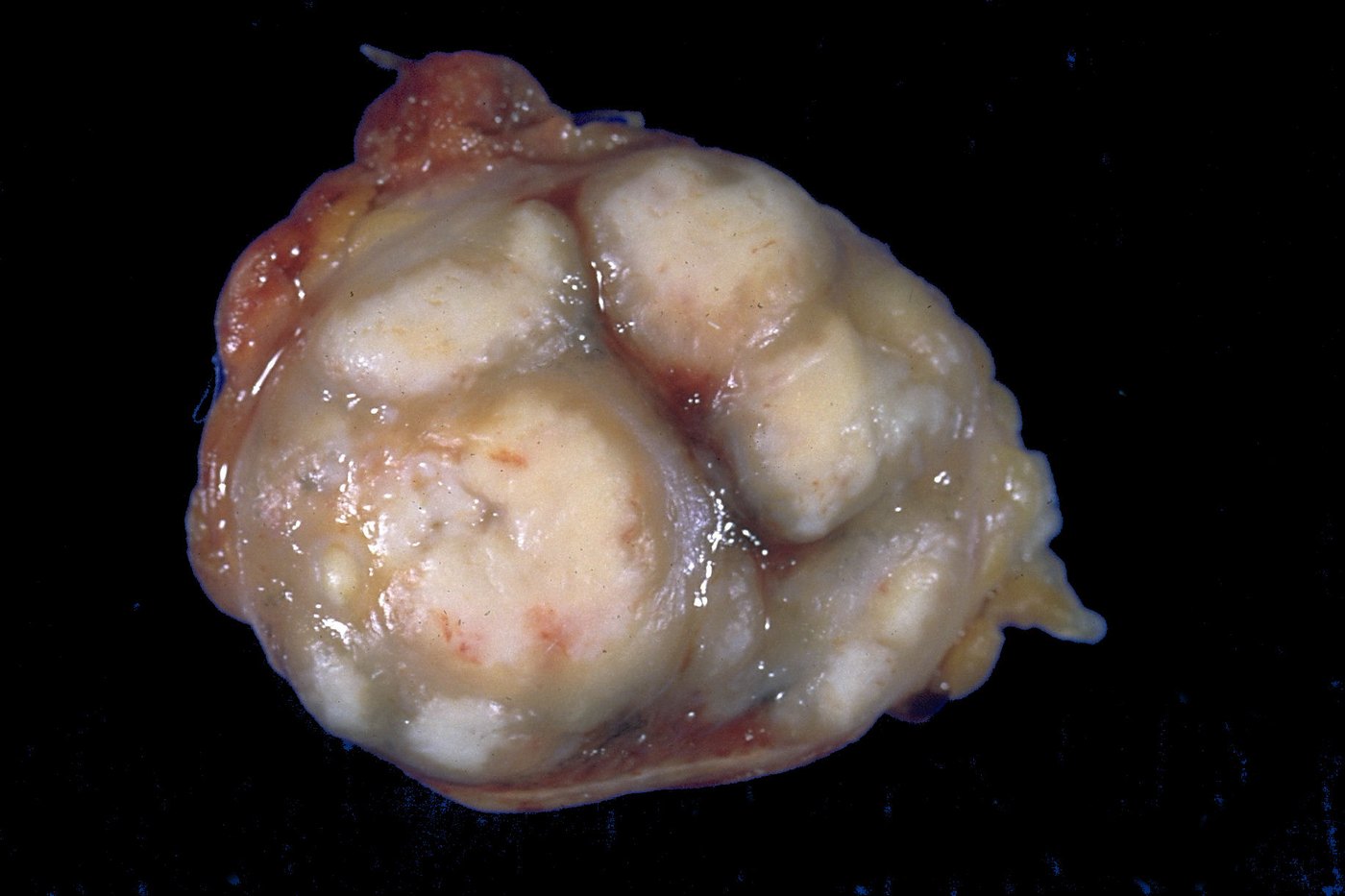
How do you describe a pot or slide quickly?
Use the same order every time, so you don't have to think about structure when the clock is running.
- Organ or tissue. What is it, and which part.
- What's abnormal. Size, shape, colour, texture, or what's out of place.
- The lesion. Describe it in a short phrase: site, size, shape, colour, edge.
- Diagnosis. Your best answer, then one or two differentials if there's space.
- Explain. Answer what the station asks: cause, mechanism, stain or complication.
Example: a cavitary TB lung (pot)
Organ: a slice of lung. Abnormal: the upper lobe, near the apex, isn't normal spongy lung. Lesion: a ragged, irregular cavity lined by soft, cheese-like caseous material and poorly walled off by fibrous tissue, with grey-white areas of caseation in the lung around it. Diagnosis: post-primary (secondary) pulmonary tuberculosis with cavitation. Explain: the cheese-like material is caseous necrosis; when it drains into a bronchus, it leaves a cavity and the patient can cough up bacilli and infect others.
Example: a caseating granuloma (slide)
Tissue: lung or lymph node. Abnormal: rounded collections of inflammatory cells replacing normal tissue. Lesion: a central pink, granular area with no cell outlines (caseous necrosis), surrounded by epithelioid macrophages, Langhans giant cells with nuclei in a horseshoe at the edge of the cell, and an outer rim of lymphocytes. Diagnosis: caseating granulomatous inflammation, most likely tuberculosis. Explain: a Ziehl-Neelsen stain can show acid-fast bacilli, but a negative stain doesn't rule out tuberculosis.
Write in short phrases, not full sentences. Steeplechase answers are often marked on key words, but ask how yours is marked.
How should you prepare for a steeplechase?
Prepare the way you'll be tested.
Test yourself, don't just reread
A large review of study methods by Dunlosky and colleagues rated practice testing and spaced-out practice as high-value techniques, and rated rereading and highlighting as low-value. For a steeplechase, that means looking at a pot or slide, covering the answer and describing it out loud or on paper before you check.
Practise with a timer
Set a timer for the time your school gives per station, and work through a set of images without stopping. When the timer goes, move on, even if you're not finished.
You may worry that the time limit will cost you marks. In one study, physical therapy students timed at one minute per station scored about the same as students who could move freely.
Revise from pictures, not just notes
You'll be shown a specimen, not a paragraph. Spend most of your revision on photos of pots and slides from your department, your textbook and your practical classes.
Use past questions and seniors
Your school's past steeplechases tell you which specimens come up and how questions are worded. One student we interviewed told us past questions are what they trust most, and that the steeplechase stations in our app stood out: "One of the parts that captured me was the steeplechase aspect of it."
What should you do on the day?
Move when the bell goes, and leave a station you can't answer. Write something for every question, even a best guess, because a blank earns nothing. Don't let one hard station follow you to the next; each one tests something different. Follow the hall rules: some schools don't allow you to touch or lift specimens.
Practise it
The tuberculosis module has steeplechase-style stations with pots and slides, where you describe, identify and explain what you see.
Sources
- University of Cambridge. Cambridge University Reporter, Part Ia Medical and Veterinary Sciences Tripos notice (2017–18, No. 6492)
- University of Guelph Library. Lab exams (bell-ringers) study guide
- Shittu LAJ, Zachariah MP, Izegbu MC, Adesanya OA, Ashiru OA. The differential impact of various assessment parameters on the medical students performance in the professional anatomy examination in a new medical school. Int J Morphol 2006;24(4)
- Zhang G, Fenderson B, Schmidt RR, Veloski JJ. Equivalence of students' scores on timed and untimed anatomy practical examinations. Anat Sci Educ 2013;6(5):281-285
- Dunlosky J, Rawson KA, Marsh EJ, Nathan MJ, Willingham DT. Improving students' learning with effective learning techniques. Psychol Sci Public Interest 2013;14(1):4-58