How to study pathology and pharmacology together
Dr Soala Reuben, Physician and pathology educator · 21 October 2026
To study pathology and pharmacology together, take one disease at a time and go through it in each specialty: what it does to the tissue, what causes it, what the blood and body chemistry show, and which drugs treat it. Then ask what links those answers. When you learn a drug, write down which disease process it targets.
What's the difference between pathology and pharmacology?
Pathology is the study of disease: what goes wrong, why and what it looks like. Pharmacology is the study of drugs: how they act on the body, how the body handles them and what harm they can do.
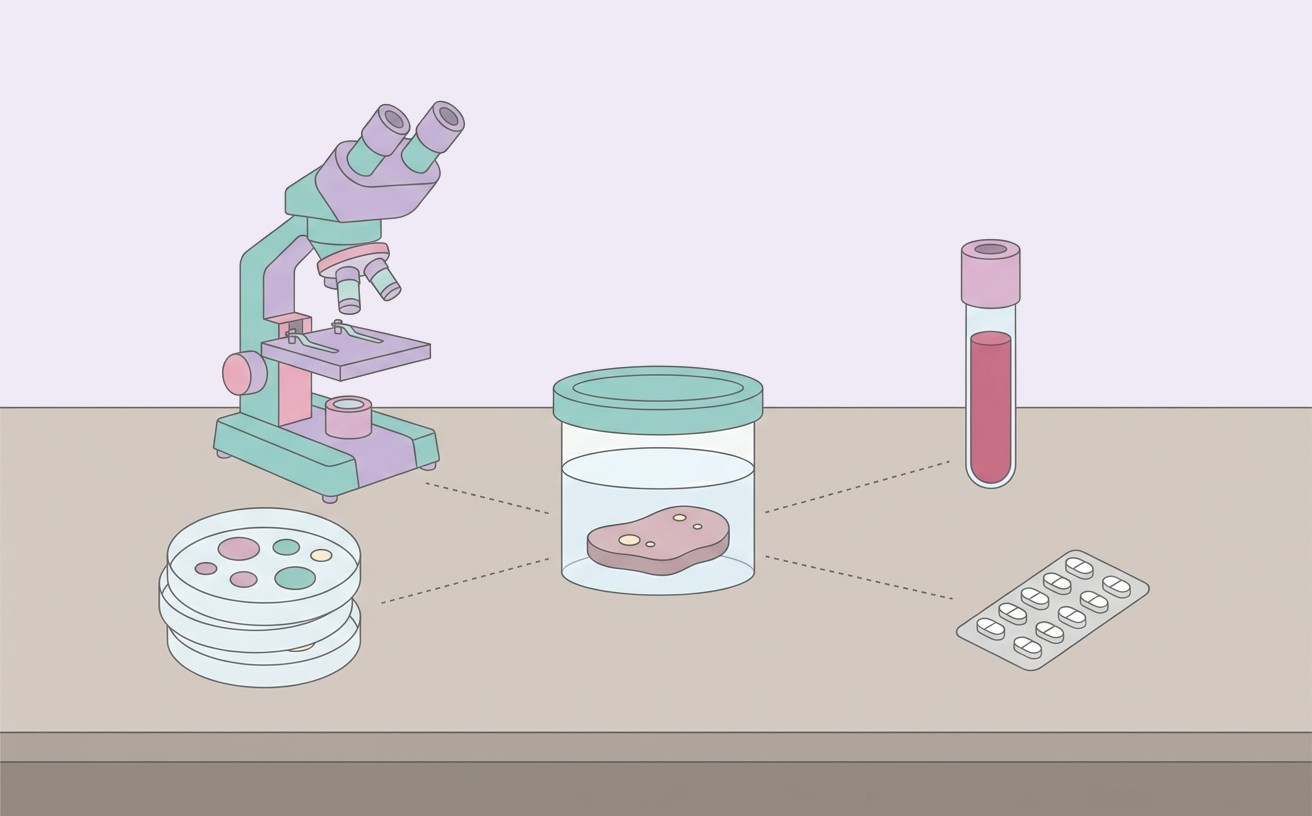
In many Nigerian medical schools, pathology is taught as four specialties:
| Specialty | What it asks |
|---|---|
| Morbid anatomy | What does the disease do to the tissue? |
| Microbiology | What organism causes it, and how do you find it? |
| Haematology and immunology | What do the blood and immune system do? |
| Chemical pathology | What changes in the blood chemistry? |
Pharmacology then asks how you treat it, and what the treatment does to the patient.
Why should you study pathology and pharmacology together?
The disease mechanism explains why a drug works and what its side effects mean. If you know the microbe's structure, you can see what the drug hits. If you know how the immune system holds a disease in check, you can see why a drug that weakens it is risky.
Questions on the wards often cross specialties too. After the diagnosis, you may be asked what the biopsy showed, what drug you'd start and what blood test you'd check while the patient takes it.
Classes do the same. Among six Nigerian medical students we interviewed in October 2026, one said the specialties are taught apart but questioned together in class, with lecturers saying things like "you should have done this in pharmacology". The same student said joined-up questions come up "maybe not in exams, but in classes".
Others noticed the gap too. One valued "the ability to connect subjects to subjects", another didn't feel ready for questions that join specialties, and one said some classmates have "a hard time connecting the dots".
What does the evidence say?
A large review of learning techniques by Dunlosky and colleagues (2013) rated:
- high utility: practice testing and spreading your study out over time (distributed practice)
- moderate utility: interleaved practice (mixing different types of problem in one session), elaborative interrogation (asking yourself why a fact is true) and self-explanation
- low utility: rereading, highlighting and summarising
The method below uses those ideas. Asking "what links these?" is elaborative interrogation. Mixing questions from different specialties is a form of interleaving. Testing yourself is practice testing.
How do you study pathology and pharmacology together?
- Pick one disease. Start with one you'll certainly be examined on.
- Go through each specialty. Write two or three facts for morbid anatomy, microbiology, haematology and immunology, chemical pathology and pharmacology.
- Ask "what links these?" Look for a fact in one specialty that explains a fact in another. Write the link in one sentence.
- Make one page per disease. Keep all five specialties and the links on the same page, so you revise the disease as one thing.
- Tie every drug to a disease process. When you learn a drug, write which disease process it targets. "Isoniazid: blocks mycolic acid synthesis in the TB cell wall" beats "isoniazid: anti-TB drug".
- Practise questions that cross specialties. Test yourself with questions that start in one specialty and end in another. Space these sessions out over weeks.
What does this look like for tuberculosis?
| Specialty | Facts |
|---|---|
| Morbid anatomy | Caseating granulomas; cavities at the lung apex |
| Microbiology | Mycobacterium tuberculosis has a waxy wall rich in mycolic acid, and it's acid-fast |
| Pharmacology | Isoniazid blocks mycolic acid synthesis |
| Haematology and immunology | Interferon gamma from Th1 cells activates macrophages; TNF keeps granulomas intact |
| Chemical pathology | Isoniazid, rifampicin and pyrazinamide can raise the liver enzymes, so ALT is checked during treatment; pyrazinamide raises uric acid |
Now ask what links these.
- Microbiology and pharmacology. The waxy, mycolic-acid-rich wall that makes the organism acid-fast is the wall isoniazid attacks.
- Immunology and morbid anatomy. The granuloma is the immune system walling the organism off. Interferon gamma activates the macrophages, and TNF keeps the granuloma intact.
- Immunology and pharmacology. Because TNF holds granulomas together, drugs that block TNF can let latent TB reactivate. That's why patients are tested and treated for latent TB before they start a TNF blocker.
- Pharmacology and chemical pathology. Three first-line TB drugs can harm the liver, so you check ALT during treatment. Pyrazinamide raises uric acid, so it can matter in a patient with gout.
For 20 TB questions and answers, see Tuberculosis questions and answers. For how the drug regimen works, see What 2RHZE/4RH means.
What do integrated pathology and pharmacology questions look like?
Integrated questions start in one specialty and need you to finish in another. Using TB, you might be asked:
- Why does the stain used to find M. tuberculosis relate to how isoniazid works?
- A patient with rheumatoid arthritis is about to start a TNF blocker. What should be done first, and why?
- A patient on TB treatment has a raised ALT. Which drugs could be the cause?
- Why might pyrazinamide be a problem in a patient with gout?
Write questions like these for each disease you study. If you can't answer one, go back to your disease page and find the missing link.
Does studying them together mean you skip each specialty?
No. You still need the core facts of each specialty, and many exam questions stay inside one. Keep reading your notes and textbooks for each specialty, then use the disease page to join them up.
Practise it
The tuberculosis module takes TB through all five specialties with the links between them. Use it to check your own TB page.
Sources
- Dunlosky J, Rawson KA, Marsh EJ, Nathan MJ, Willingham DT. Improving students' learning with effective learning techniques. Psychol Sci Public Interest 2013;14(1):4-58