The organism
Key facts
- M. tuberculosis is a slow-growing, acid-fast obligate aerobe, so it infects the oxygen-rich apices.
- The mycobacterial lipid wall holds red carbol fuchsin through an acid alcohol wash, so the bacilli show as red rods on a methylene blue counterstain.
- Culture takes up to six weeks on solid medium, or about two in liquid, and mustn't delay treatment.
Mycobacterium tuberculosis is a rod-shaped bacterium, or bacillus, that causes tuberculosis. It's acid-fast, it's an obligate aerobe (it needs oxygen to survive), and it grows very slowly.
| Organism | Key point |
|---|---|
| Mycobacterium tuberculosis | Tuberculosis. |
| Mycobacterium leprae | Leprosy. |
| Non-tuberculous mycobacteria | Over 100 other species, grouped together. |
| Nocardia | The other major acid-fast organism, outside the mycobacteria. |
How the Ziehl-Neelsen stain works
- Red stain, with heat. The smear is covered with the red dye carbol fuchsin and heated, so the dye gets into the waxy wall.
- Acid alcohol. Acid alcohol is poured over the smear. It removes the red dye from most bacteria. The lipids in the mycobacterial wall don't dissolve, so these rods stay red.
- Blue counterstain. Methylene blue is added. Everything that lost the red dye now takes up the blue.
- Reading the smear. Acid-fast bacilli are red rods on a blue background. They hold fast to the red stain, which is where their name comes from.
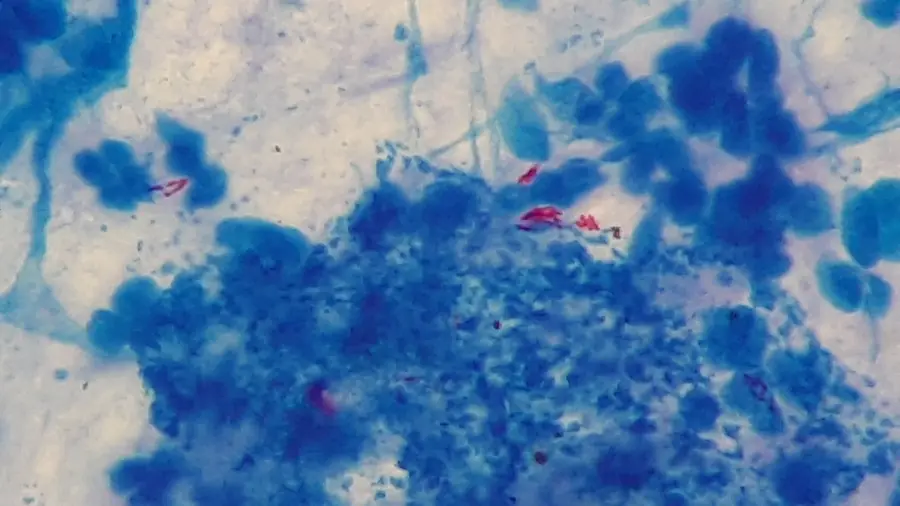
- Acid-fast bacilli Slender red rods. Carbol fuchsin is driven into the wall with heat, then acid alcohol is poured over the smear. The wall lipids do not dissolve, so the rods stay red.
- Methylene blue counterstain Everything that lost the red stain takes up the blue counterstain. The blue makes the red rods easier to see.
- Obligate aerobe
- It needs oxygen. It infects the lung apices, where oxygen is plentiful.
- Slow growth
- Up to six weeks for visible growth on solid medium. Liquid culture is faster, within about two weeks. Culture must not delay treatment.
- Clumped colonies
- The lipid wall makes the organism hydrophobic. So the bacteria clump on solid media and float as blobs in liquid media.
- Survival outside the body
- Its lipid wall. The organism resists weak disinfectants and survives on dry surfaces for months.
| Pattern | Who gets it | What it looks like |
|---|---|---|
| Lung disease | Older adults, especially those who smoke, have chronic obstructive lung disease or drink heavily | Upper lobe cavities that look like tuberculosis |
| Disseminated M. avium complex | Advanced HIV, usually with a CD4 count below 100 | Fever, night sweats, weight loss, an enlarged liver and spleen, and diarrhoea. Tissue shows sheets of macrophages full of bacilli, and no granulomas |